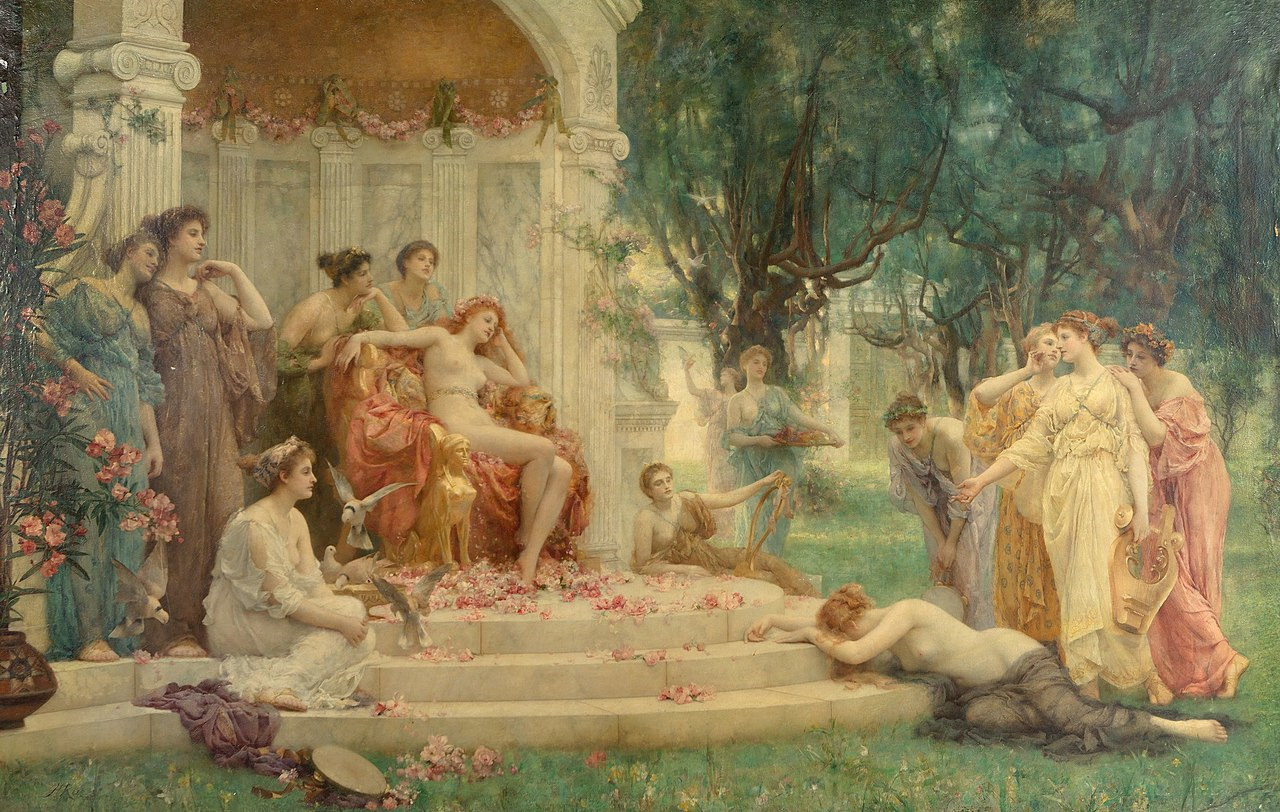
Henrietta Rae (British, 1859-1928)
Psyche before the Throne of Venus, 1894
 Arthur Freitas
Hoje eu lembrei que a Vivi gostava de se tapar na hora de dormir. Eu tinha esquecido desse detalhe.
The Boundless Legacy of ‘Breath of the Wild’
Lewis Gordon, The Ringer:
On the one hand, a sense of adventure that has few peers in video games: wanderlust, dread, the sublime, all achieved within a vast, meticulously designed open world. On the other, systems and mechanics that combine in such a way that they both react physically to the player and seem to exist independently of them, alternately inspiring awe and glee and making a virtual setting feel truly alive.
By the mid-2010s, Ubisoft’s icon-filled open-world “map games” (a pejorative term expressing players’ frustration with having to scour a map to find things to do rather than looking at the world itself) had reached their logical extremes
[…]
At their most cynical, these ballooning virtual spaces appeared less like living, breathing worlds than sites to consume ever more content.
Breath of the Wild was born from a crystalline picture: Link climbing a cliff before paragliding to the ground below, moving seamlessly from rock to air, and then, finally, landing comfortably on terra firma. There was more, though: survival and what director Hidemaro Fujibayashi called the “creativity of combination”—for example, lighting wood with fire to create a larger bonfire. The Zelda series, whose game mechanics were usually so precise and predictable, would open itself up to the natural elements. In the process, it would have to embrace a degree of chaos and chance.
Central to the game’s production was figuring out how such a world should behave. After all, a space that lacks consequence, friction, or discord is arguably one without life.
What Nintendo’s game gave Kythreotis, beyond direction about how this mechanic should function, was a sense of belief—not just in himself and Fineberg, but in the player, who with expanded input would become more of a “collaborator in the experience.”
Maybe Breath of the Wild is the Platonic ideal of a type of action game that almost everyone who has ever picked up a controller has envisioned: one in which a lone warrior explores a mythic landscape that responds to their actions in a meaningful way. […] Perhaps because Nintendo operates according to its own set of rules, forgoing the graphical arms race to focus on design, it was able to burrow deeper than anyone else into the systems that bring such a game to life. As Kythreotis stresses, “Zelda is never trying to be a film. It wants to tell its story through systems and mechanics. It embraces video games as a form.”
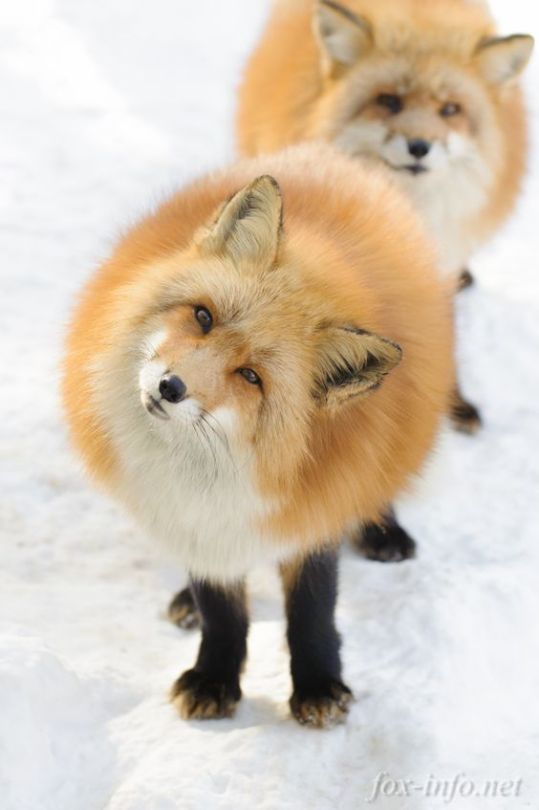
did i tell u guys i got into an argument on twitter bc i said foxes are dogs and someone tried to bring up their actual fuckin. classification or whatever and i just said “foxes are dogs cause they are fluffye” and they kept arguing with me. the entire time i was like “you will not survive the immigration to tumblr you are lucky we are not there right now”
This is especially funny because they aren’t even right. Foxes *ARE* dogs.
No they aren’t.
yes they are. because they are fluffye.
OK yes they are.
Dog
Dog
Different family, but same order as @pictures-of-dogs
No, they are the same family. They are the same kingdom, phylum, order and family. They separate at the genus.
They’re a dog.
yeah they’re fluffye
theyre literally not dogs theyre not even fluffy. can we get science tumblr over hear or what!?
checkmate athiests
fluffye
okay but they literally are dogs, for those who are confused
If foxes are dogs, then so are wolves, coyotes, dingoes, jackals, and several other extant and extinct species.
Behold! A dog.
of course it’s a dog you buffoon. it’s fluffye.
Why on earth would someone think “BUT IF THEY’RE DOGS SO AR -”
Like yes of course wolves are dogs, where have you been. Jackals are excellent doggies! So are coyotes. Why is this confusing.
I love that this is literally two completely different arguments running simultaneously.
That guy up there who said they’re not even fluffy was thinking of sharks
sharks are also dogs. ravenous water dogs, but still dogs
Sharks can NOT be dogs they are SMOOTH
Uma coisa que acho que agradaria todo o mundo com a próxima geração do Nintendo Switch seria “mover” as bibliotecas do Nintendo 64 e do Game Boy Advance para o plano normal do Nintendo Switch Online, e trazer GameCube e Nintendo DS pro Pacote de Expansão.
Yes, this philosophy is pretty limited, and it will almost always only apply to your small projects that you decided to build over the weekend. However, sometimes it’s nice to be reminded of how simple the web can be and how a little can go a long way.